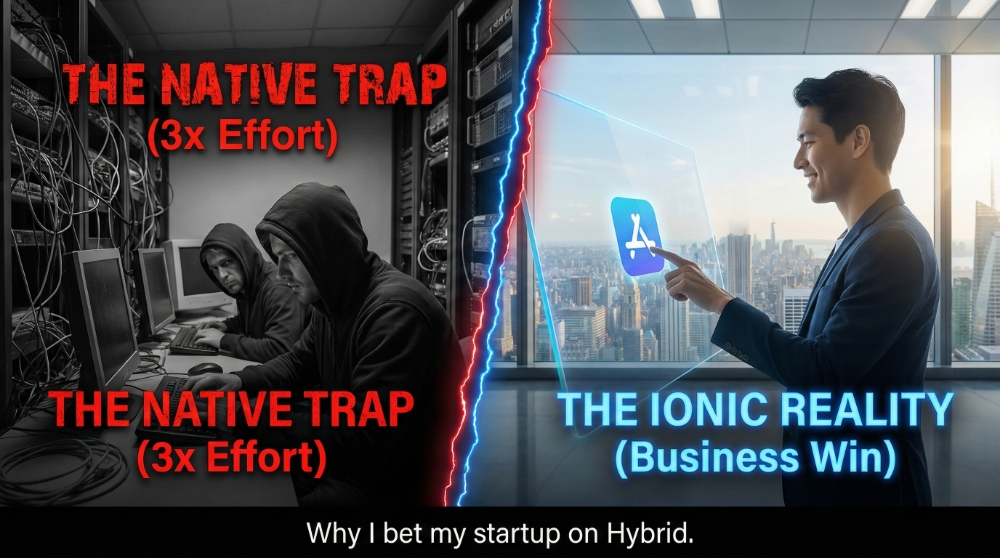
If you ask a room of developers what to use for a mobile app today, 80% will shout "React Native!" or "Flutter!". When I chose Ionic (Angular) for my own projects, people thought I was taking a shortcut.
They were wrong. I wasn't taking a shortcut; I was making a strategic business decision.
Here is the reality developers forget: Users do not care about your stack. They care about the experience. They care that the app opens, works, and solves their problem.
With Ionic and Capacitor, I have access to the exact same Native APIs—Camera, Geolocation, Push Notifications—as the other guys. But here is the superpower that React Native can't beat: I share 95% of my code between my web platform and my mobile app.
As a Founder of Future Door, I don't have the budget or the time to:
- Hire separate iOS and Android teams.
- Maintain three isolated codebases (Web, iOS, Android).
- Rewrite business logic in Swift or Kotlin.
Ionic allowed me to build Future Door once and deploy it everywhere. We use Angular, leveraging modern Signals for state management, and compiled it all into native binaries using Capacitor.
Is "Native" performance technically better? Maybe by milliseconds on a complex animation. Does it matter for a CRUD app, an E-commerce store, or an Educational platform? Absolutely not. Modern devices are too fast for the difference to be noticeable to the average user.
If you are a startup founder, stop over-engineering. Stop optimizing for "what if we become Facebook" and start optimizing for shipping. Ionic isn't just a framework; it's a launchpad.
Muhammad Nouman